
One of the things I have learned since I started organising weddings in Crete in 2010 is that knowing the law and knowing how things actually work are not necessarily the same thing.
If you have been researching how to get legally married in Greece, you have probably come across rather contradictory information. One wedding planner tells you that you can get married on a beach, another insists that you must go to the Town Hall, and a couple who got married here three years ago describes an entirely different experience. The amusing thing is that all three may be telling the truth..
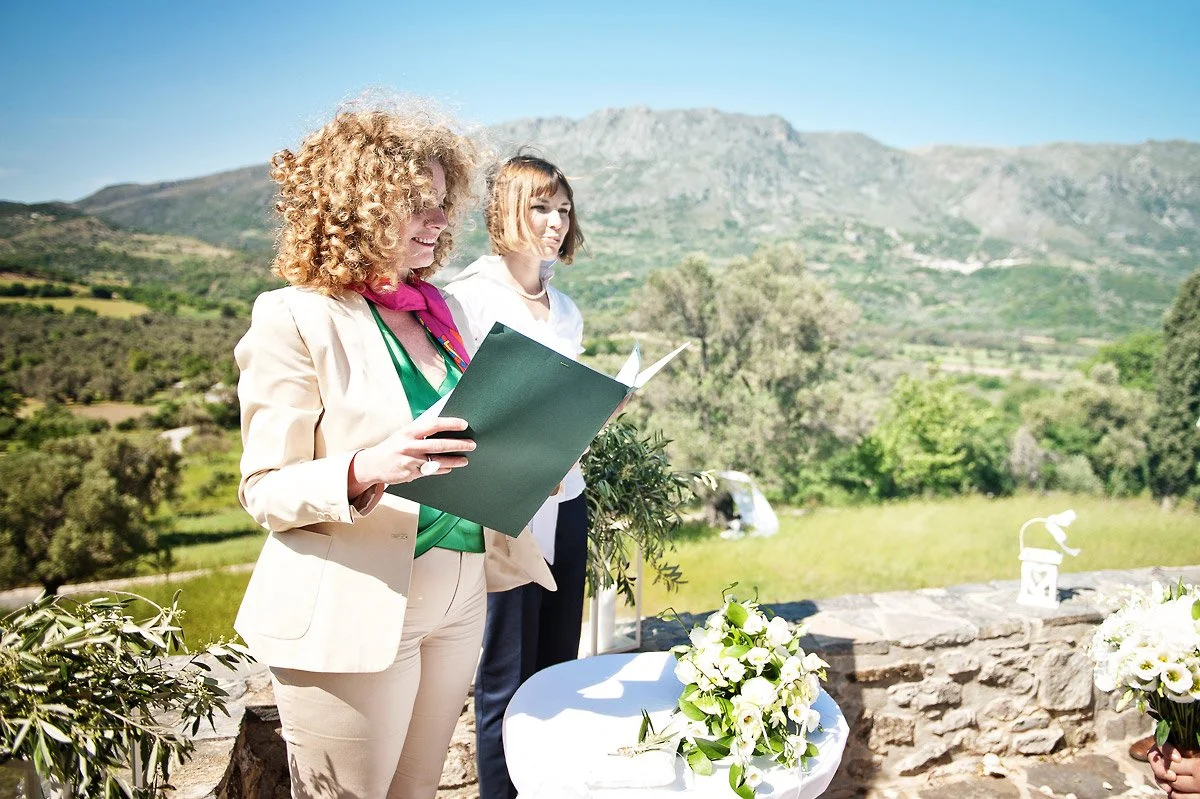
Outdoors legal ceremonies are not available everywhere in Greece
Same Island, Same Country, Different Rules
Greece has a national legal framework for civil marriages. However, the practical arrangements are largely handled by local municipalities. And this is where things get interesting.
Take Heraklion and Rethymno, for example. Two cities on the same island, roughly an hour and a half apart by car, yet with quite different approaches to organising civil weddings.
In Heraklion or Chersonissos the town hall performs civil weddings in 2027 only twice per week, usually around midday. Yes, this often means waiting in line, limited flexibility, and very specific timing. In 2026 it was free of charge.
At the same time, Rethymno town hall performs civil weddings for foreign couples daily, and even on weekends. The fee is typically €150 for a ceremony in the townhall, or €400 -650 for an outdoor civil ceremony.
So when a couple asks me how much a civil wedding costs in Crete or whether they can get married on a Saturday, my first question is usually: where exactly in Crete? The answer makes quite a difference.
A Beautiful Wedding Venue Does Not Necessarily Mean a Legal Ceremony Is Possible There
Imagine finding a magnificent olive grove, a secluded villa or a restaurant overlooking the Mediterranean. You fall in love with the place, book it and then discover that the local municipality cannot conduct a civil marriage ceremony there. Not exactly the discovery you want to make halfway through planning your wedding.
Some municipalities accommodate outdoor civil ceremonies at approved locations. Others have much more restrictive arrangements. A venue that hosted a legal wedding last season may not necessarily be able to offer the same option next year.
This is why photographs of previous weddings are not sufficient confirmation. Whenever a couple tells us that an outdoor legal ceremony is important to them, we check the arrangements directly with the venue and the relevant municipality before proceeding. Sometimes the answer is yes. Sometimes we need to look for another location. And sometimes we suggest a slightly different wedding scenario.
It is much easier to have this conversation before paying a venue deposit.
Why We Prefer to Check Everything Before Saying Yes
After years of working with Greek authorities, I have developed a certain respect for the word confirmed. There is a considerable difference between something being theoretically possible and having the necessary arrangements in place for a particular couple, at a particular location, on a particular date.
This applies to paperwork as well. Two couples travelling from the same country may have different citizenships, different family circumstances and, consequently, different documentation requirements. There are also questions of document validity, certification and official translations.
Our advice is simple: establish exactly what you need before you start collecting documents. For a more detailed explanation of the legal requirements, preparation time and ceremony options, visit our dedicated page on Civil Weddings in Crete.
Does the Official Ceremony Have to Be Your Wedding Ceremony?
This is a question worth discussing before you start planning. For some couples, the moment they officially become married is emotionally important. They want their guests to witness it, and they want the legal ceremony to be an integral part of their wedding celebration. I completely understand that.
Other couples are more interested in the freedom to choose an extraordinary location, write their own vows and have a ceremony at sunset without having to consider municipal working hours. In this case, separating the legal marriage from the symbolic ceremony can make a great deal of sense.
You can complete the legal formalities at the Town Hall and celebrate your wedding somewhere entirely different, either later that day or on another date. Neither option is more romantic or more authentic than the other. It simply depends on what matters to you.
What Happens When You Cannot Change the Wedding Date?
In September 2026, we organised a civil wedding in Heraklion for Sean and Mary, a couple from Scotland who travelled to Crete to get married just the two of them. Everything was arranged, the documents were ready, and the Town Hall appointment was confirmed. Then came what was quite possibly the rainiest day of that September.
Under different circumstances, we might have suggested postponing the wedding. But the couple were only spending a week on the island, and the next available municipal ceremony date was the following week. So there was very little to discuss. We found an enormous umbrella and carried on.
Sean and Mary got married, exchanged their vows and celebrated over dinner in the city. Their story is a good illustration of something that is easy to overlook when planning a destination wedding: an official ceremony introduces certain practical limitations into your wedding itinerary.
Knowing what can and cannot be changed helps us plan a much more realistic day.
A Final Word of Advice
Getting legally married in Crete is perfectly achievable for many international couples, and it can be a wonderful experience. But if a legal ceremony is essential to you, I would strongly recommend establishing the administrative possibilities before making the creative decisions.
Find out which locations are available, how flexible the municipality is, what documents you need and whether your preferred date is realistic. Then we can get on with the considerably more enjoyable part of wedding planning. And believe me, there is plenty of that in Crete.
From Crete with love!